

Tungsten carbide hammer - Straightening hammer for knife blades - NIROC
Tax included.

Shopping with us is risk-free
Thousands of satisfied customers
Fast delivery
(1-3 days)
Buy now,
pay later
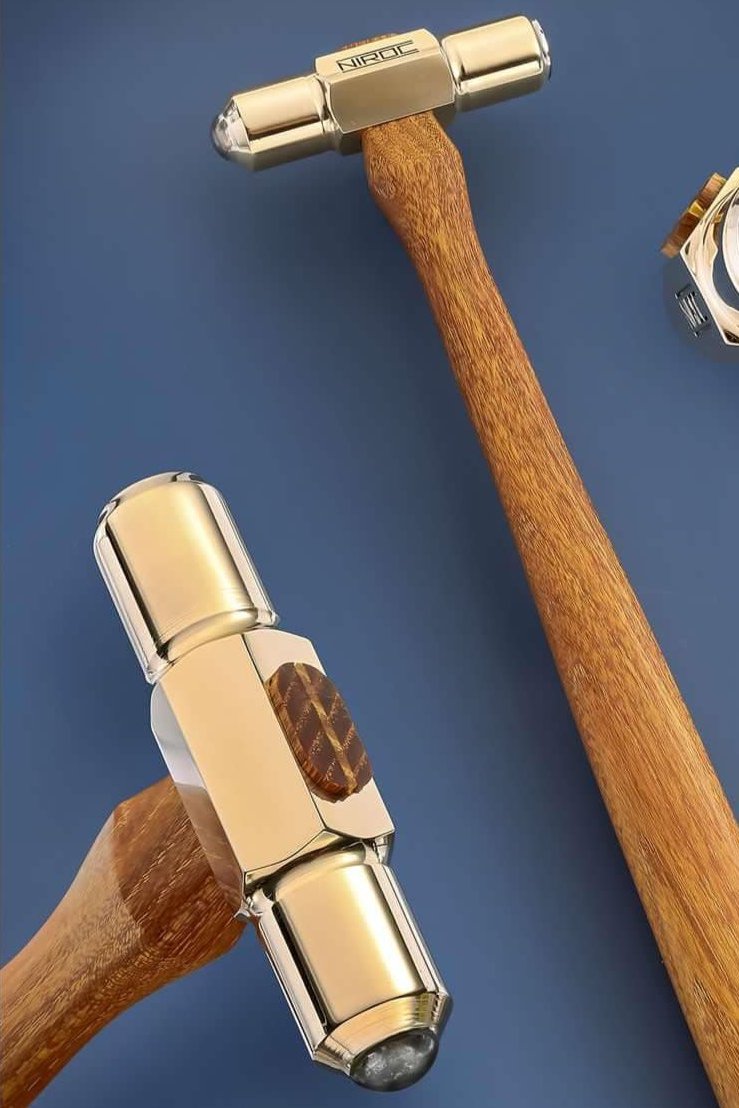
Here is the well-known carbide hammer - the NIROC hammer that helps you straighten out crooked pieces of steel and knife blades. A few light taps with the hammer on the bend, and the steel straightens out almost magically. Feel free to use it together with the Niroc precision-ground small anvil as a base.
The original Tungsten Carbide Niroc Knockometer
Carbide hammer for straightening blades
"If your blade is a rockin’, the NIROC comes a knockin’"
You can straighten a regular unhardened piece of steel with an ordinary hammer, but to straighten knife blades that have warped during the hardening process, you need something harder. That is why this hammer has a carbide ball on the front. It gives you the hardness you need to straighten the blade without it cracking.
The rounded carbide side of the hammer gives you the ability to straighten the blade.
The flat side is perfect for peening brass pins and other small tasks!
See the hammer in use here, by the inventor himself:
More information from the manufacturer
Weighing approximately 160 grams (5.6 oz), the Niroc Knockometer was originally designed as a blade straightening hammer (tagane hammer). It is also highly valued by sheet metal workers, toolmakers, leather workers, saw doctors, and tool repairers. This is a useful tool for anyone who needs a small, but very hard hammer.
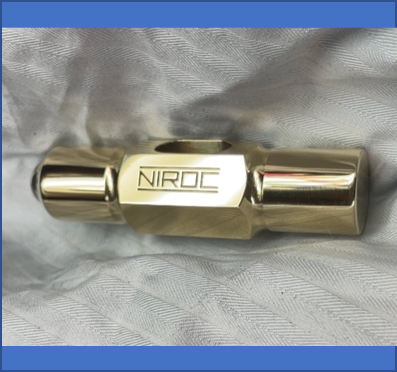
These are handmade, and great emphasis is placed on creating a beautiful tool that, with proper care, will last a long time. The hammer heads are machined from brass rods. Brass is chosen for its relative density (heavier than steel for the same volume) and ability to deform. This "seats" the carbide and reduces the likelihood of chipping or breaking. The carbide inserts are silver soldered in place with an alloy containing 45% silver, and the process ensures that the insert sits securely.
The eye in my hammers is an integral part of the design and ensures that the head sits firmly on a handle, whether mounted by me or by you. I machine the eye with an hourglass-shaped constriction, making it narrower in the middle. When attached to a tapered handle and wedged into place, there is minimal risk of it coming loose.
Hammer handle:
Each handle mounted by me is shaped to fit the hammer eye exactly and is carefully wedged in place with Osage Orange wedges. This is a time-consuming process, but it is worth the effort to achieve an optimal result.
The Australian factory-produced handles are made of "spotted gum," a wood known for its strength and suitability for tool handles. I only use about 70% of the factory handles, removing anything that does not meet my quality standards. Although they are not always symmetrical, this gives the user a feel for the hammer's orientation and they are comfortable to use. These handles are shorter and vary in color from light brown to dark red, depending on the wood's origin.
My guarantee:
If something is not right, I will fix it or replace it. If something goes wrong, let me know.
I have worked in customer service my entire professional life, directly and indirectly. I know that things can go wrong, but how I handle it defines my business. Please give me the opportunity to make it right.
Another example, which also shows in detail how you can straighten your warped blades, and even make your own!
We ship almost all orders on the same business day if you order before 2:00 PM.
Standard delivery time: 1–3 business days with Bring.
Customers in Northern Norway may experience an extra day or two in some cases.
Tracking:
You will receive a tracking number via email as soon as the package has been shipped.
100% satisfaction guarantee:
We are completely confident that you will be satisfied. We are so confident that we offer both a full return and coverage of return shipping. Regardless. So, it is completely risk-free for you to order now to inspect the product yourself in your own home and at your own pace.
We also stock spare parts and wear parts, so if you should be unfortunate enough to break something or, against all odds, manage to wear out the sharpening stones, these can be easily replaced.
Easy returns:
Contact our customer service, and we will send you a pre-filled return label.
No questions asked – no risk
Description:
Here is the well-known carbide hammer - the NIROC hammer that helps you straighten out crooked pieces of steel and knife blades. A few light taps with the hammer on the bend, and the steel straightens out almost magically. Feel free to use it together with the Niroc precision-ground small anvil as a base.
The original Tungsten Carbide Niroc Knockometer
Carbide hammer for straightening blades
"If your blade is a rockin’, the NIROC comes a knockin’"
You can straighten a regular unhardened piece of steel with an ordinary hammer, but to straighten knife blades that have warped during the hardening process, you need something harder. That is why this hammer has a carbide ball on the front. It gives you the hardness you need to straighten the blade without it cracking.
The rounded carbide side of the hammer gives you the ability to straighten the blade.
The flat side is perfect for peening brass pins and other small tasks!
See the hammer in use here, by the inventor himself:
More information from the manufacturer
Weighing approximately 160 grams (5.6 oz), the Niroc Knockometer was originally designed as a blade straightening hammer (tagane hammer). It is also highly valued by sheet metal workers, toolmakers, leather workers, saw doctors, and tool repairers. This is a useful tool for anyone who needs a small, but very hard hammer.
These are handmade, and great emphasis is placed on creating a beautiful tool that, with proper care, will last a long time. The hammer heads are machined from brass rods. Brass is chosen for its relative density (heavier than steel for the same volume) and ability to deform. This "seats" the carbide and reduces the likelihood of chipping or breaking. The carbide inserts are silver soldered in place with an alloy containing 45% silver, and the process ensures that the insert sits securely.
The eye in my hammers is an integral part of the design and ensures that the head sits firmly on a handle, whether mounted by me or by you. I machine the eye with an hourglass-shaped constriction, making it narrower in the middle. When attached to a tapered handle and wedged into place, there is minimal risk of it coming loose.
Hammer handle:
Each handle mounted by me is shaped to fit the hammer eye exactly and is carefully wedged in place with Osage Orange wedges. This is a time-consuming process, but it is worth the effort to achieve an optimal result.
The Australian factory-produced handles are made of "spotted gum," a wood known for its strength and suitability for tool handles. I only use about 70% of the factory handles, removing anything that does not meet my quality standards. Although they are not always symmetrical, this gives the user a feel for the hammer's orientation and they are comfortable to use. These handles are shorter and vary in color from light brown to dark red, depending on the wood's origin.
My guarantee:
If something is not right, I will fix it or replace it. If something goes wrong, let me know.
I have worked in customer service my entire professional life, directly and indirectly. I know that things can go wrong, but how I handle it defines my business. Please give me the opportunity to make it right.
Another example, which also shows in detail how you can straighten your warped blades, and even make your own!